- MJF-Bandido was a template for MJF going forward, the great Mercedes promo most fans didn’t see
- Virat Kohli dethrones Rohit Sharma, becomes No. 1 batter in ODI Rankings for the first time since 2021
- How to watch Chelsea vs Arsenal: Live streams, TV details
- India vs New Zealand 2nd ODI 2025: India announces their Playing 11, as Team New Zealand Wins the Toss and Elects to Bowl First Against India
- A Hollywood ending? Inside the final days of LeBron James in Los Angeles
- Everton: How Kiernan Dewsbury-Hall is thriving after Chelsea exit
- WWE Planning Big Event For Italy In 2026
- Scottish gossip: Doig, Raskin, Gassama, Neilson, Ageu, Glasgow, Jikiemi
Browsing: worth

GOLF’s latest ranking of Top 100 Courses in the World features plenty of familiar names, from Augusta National and Pine Valley to Cypress Point and Pebble Beach. But tucked amid those icons are lesser-known layouts with compelling designs and rich histories of their own. In this ongoing series, we’ll introduce you to them.
In 1930, English architect Charles Alison stepped ashore in Tokyo from the steamer Asama Maru for a three-month visit. In that brief time, he ignited Japan’s golfing soul. Alison left his signature on four prominent courses around Tokyo — Tokyo Golf Club, Hirono, Naruo, and Kasumigaseki.
But his true masterpiece unfurls two hours south of the capital: the Fuji Course at Kawana, draped across storm-sculpted cliffs that mirror Big Sur’s savage beauty, with sacred Mount Fuji itself rising above the clouds and visible throughout the course.
Of the many fine holes, two stand out for their mix of natural beauty and strategy.
The 7th, a mere 393-yard par 4, tumbles toward a pulpit green kissed by dappled light reflected off the ocean. From the tee, the hole seduces with the promise of driving the putting surface, yet Alison’s deep bunkers slash the fairway in two, demanding a decision: the generous right side grants a straightforward approach, albeit from a severely sloped lie; the more daring angle up the left rewards with a level lie but a delicate pitch over flashed bunkers.
The 15th, a 480-yard par-5, plunges from a sky-high tee to a fairway that abuts towering bluffs along the Pacific. Wind and slope make eagle a possibility, but bunkers right push play left toward the cliffs. The rippled fairway climbs to a narrow, two-tiered green, where par is a strong score.
Kawana must be played to be fully appreciated. And that’s the thing: anyone can. Unlike most of Japan’s top courses, Kawana is accessible to the public. It’s part of a resort. Its sibling Oshima Course (measuring a modest 5,711 yards) shares similar strategic demands on a smaller scale and serves as an ideal warm-up or twilight companion to the Fuji, making for an all world 36-hole adventure.
Noel Freeman is a course rater for GOLF and Golf.com.
If you’ve been holding back on purchasing the big-ticket items on your holiday wish list, now is the perfect time to buy, because for a limited time at Fairway Jockey, you can earn 2X points when you spend $500 and 3X points when you spend $1,000 — and a mystery holiday gift box worth $500 too!
The mystery holiday gift box is one of the season’s most coveted items. Each box is packed with a surprise assortment of premium gear, like headcovers, ball markers to high-quality towels. One in every three holiday boxes even includes a custom putter, and each one has a retail value of more than $500!
And let’s not forget about the points! Earning points with Fairway Jockey’s Jockey Club is the fastest way to scoring free gear. Simply signing up earns you 200 points, right on the spot! Start earning by clicking here. Once your account is established, you can earn one point per dollar spent. And there are numerous other ways to earn points:
-Make three purchases (250 points)
-Follow Fairway Jockey on social media (10 points each for Facebook, X, Instagram and TikTok)
-Leave a product review (100 points)
-Add a photos to a review (50 points)
-Add a video to a review (50 points)
-Birthday bonus! (500 points)
Then … use those points!
Points will automatically accumulate when you’re signed in to your Jockey Club account, and using them is easy! A stockpile of 500 points is worth $25; 1,000 points is $50; 2,000 is $100; and 4,000 points is $200. Points accumulate automatically. When you’re ready to redeem, simply copy and paste your code at checkout.
Spending $1,000 or more also unlocks access to even more rewards tiers, with benefits like additional earned points, early access to sales and a VIP assortment of products.
At dusk, when the patio lights came on and the after-dinner crowd showed up, things got interesting at Butler Pitch & Putt. And, nursing my IPA on a warm spring evening in downtown Austin, I sat at a picnic table near the first tee and watched a few groups tee off. First up, a young couple — ripped jeans and T-shirts — headed to the blocks. The young lady — split grip, hunched posture, up and down like a yo-yo — needed six swings (I counted) to make contact. Her companion then took a vicious lunge and nuked one straight left over the railway tracks into Never-Never Land. I ordered another. Austin’s golf scene was growing on me.
The long and storied golf history in Texas hardly needs an introduction. So I won’t give it one. But Austin — think Dallas with tatts and a nose-ring — is cut from a different cloth. Things are a little “weird” there. And most Austinites seem to like it that way. (“Keep Austin Weird” is a slogan the city wears with pride.)
Unquestionably, the inner-city, anything-goes, all-are-welcome vibe at Butler is the quintessential example. This is a place, now 75 years old, where golfers in mini skirts, tank tops and funky-patterned pumps fit in better than country-clubbers with pleated pants and collared golf shirts. “No shoes, no tee time, no problem” is the official mantra of the place. Some would argue — and I’d be in that camp — that golf needs places like Butler. It’s simply in a league of its own. Without it, thousands of Austinites would never have learned or been introduced to the game.
The “clubhouse” of the Butler Pitch & Putt in Austin, Texas.
Andrew Penner
But, as hip and “ungolfy” as Butler is, make no mistake, it is a golf course. There’s a clubhouse (your closet might be bigger), food and beverage (craft beer in the clubhouse and a Gimme Burger food truck outside in the courtyard), and there are nine quirky holes that vary in length from 61 to 101 yards. No golf clubs or golf balls at your disposal? No problem. They also rent clubs and balls for a dollar. (An extra ball, or two, might come in handy. The railway tracks and Lee Barton Drive are kinda close.)
Of course, Butler, as cool and quirky as it is, isn’t the only golfing lifeline for Austin’s inner-city folk. Located just west of the downtown core, Lion’s Municipal Golf Course is another local institution with legendary status. And its pedigree, its history, as an irreplaceable “treasure” in downtown Austin, is every bit as compelling. Unfortunately its status — hence the ongoing “Save Muny” campaign — is in jeopardy.
Built in 1924, Lion’s Municipal (everyone simply calls it “Muny”) is a grassroots, blue-collar municipal course where legends such as Ben Crenshaw and Tom Kite learned the game and honed their craft. Many other notable players — Ben Hogan, Byron Nelson and the local teaching legend, Harvey Penick, come to mind — were regular patrons.
True, Lion’s won’t blow you away with timeless, Golden Age architecture (B.F. Rowe is credited as the original architect, however, A.W. Tillighast did give it a tweak in 1936), a regal clubhouse or phenomenal turf conditions. But there is an aura there, a status in the community, that puts Muny in rarefied air.
A golfer hits an approach at Lions Municipal.
Andrew Penner
“Muny does over 70,000 rounds a year,” says Scotty Sayers, who is a co-chair with Ben Crenshaw on The Muny Conservancy initiative that was launched a number of years ago to preserve the course. “Our mission is to preserve, restore and protect this iconic course. It would leave a huge void in the community if it disappeared.”
Although it’s complicated, Muny’s precarious position is due, in large part, to future expansions, infrastructure issues, and so on, that could be coming down the pipe with the current landowner, the University of Texas. The City of Austin operates the course but leases the land from the University. And it’s been that way since 1937.
However, the “Save Muny” campaign has plenty of traction and hope remains high that the course will be saved. Besides Crenshaw, arguably Muny’s greatest advocate, many other PGA Tour players, celebrities, musicians and personalities are lending a hand to the cause. Jordan Spieth, musicians Willie and Lukas Nelson, and actor Luke Wilson are just three examples. (Recently, a bill passed to push the dissolution date to May 2027.)
Angela Garcia, an Austinite and the wife of Sergio Garcia, also sits on the Save Muny Board of Directors. And the Garcias (Sergio occasionally shows up at Muny unannounced and joins a group of junior golfers) have been strong advocates for years.
“Muny isn’t just a golf course,” says Angela Garcia. “It’s a way of life. The golf course serves as an after-school and weekend home to hundreds of junior golfers in Austin. It’s where over a dozen junior high and high school golf teams practice every day. There are many kids who wouldn’t be able to play golf if Muny didn’t exist.”
Sergio Garcia, Verne Lundquist and Ben Crenshaw at one of the Muny fundraisers.
Courtesy Photo
Garcia, who met Sergio during her reporting stint at Golf Channel, also has a strong personal connection with Muny. A former player on the UT golf team, Garcia played and practiced at Muny regularly in the mid-2000s. “The giant heritage oak trees on Muny are really impressive and one of my favorite aspects of the course,” says Garcia. “These are some of the most beautiful trees you will ever see. If we don’t save Muny, we will lose a cherished place in our community that kids for generations to come will enjoy and use as a refuge.”
Fittingly, in 1950 Muny was also the first golf course in the south to desegregate. In fact, it’s listed in the National Register of Historic Places for its role as a civil rights landmark. It became a place where all people, regardless of color, creed or culture, could tee it up and play golf.
And, for the record, there is nothing remotely “weird” about that.
Where else to play
If you’re looking for the ultimate Texas two-step, two of the state’s resorts landed in GOLF’s Top 100 Resorts in the World. There’s Omni Barton Creek Resort & Spa (20 minutes west of downtown Austin) and Omni PGA Frisco Resort & Spa (30 minutes north of Dallas/Ft. Worth International Airport). Both offer luxurious accommodation, award-winning golf courses, exceptional dining, world-class spa experiences and more. Check out December promotions here. And for more Austin-area golf, check out Lost Pines Golf Club east of town, The Golf Club at Star Ranch north of the city, Kissing Tree Golf Club to the south and, about an hour west, a handful of courses at Horseshoe Bay Resort.
-
André SnellingsDec 1, 2025, 09:00 AM ET
- Dr. André Snellings is a senior writer for men’s and women’s fantasy basketball and sports betting at ESPN. André has a Ph.D. in biomedical engineering from Michigan. He joined ESPN in 2017 after a 16-year career as a neural engineer, during which time he was also a writer and analyst for Rotowire.
Victor Wembanyama is one of the NBA’s best players, but does he have a real chance to win his first MVP award this season after missing the past two weeks with a calf injury?
The odds are against him — he enters December at 150-1 to win the award on DraftKings Sportsbook — but the San Antonio superstar shouldn’t be counted out.
Wembanyama is as unique a player as the NBA has ever seen. If you look up his profile in basketball-reference, his nicknames are listed as “Wemby,” “The Extraterrestrial” and “Alien.” The last two, given affectionately, are because us mere earthlings don’t know what else to call a man who is 7-foot-4 (and still growing) who plays like a tall shooting guard on offense (complete with crossovers and Shammgods off the dribble, and Stephen Curry range) while also defending at a historically elite level.
Wembanyama’s 26.2 PPG ranks 15th in the NBA. His 12.9 RPG leads the league. And his 3.6 BPG is well in front of anyone else. He is top 5 among centers with 4.0 APG and top 10 at the position with 1.7 3PG, and he does all this while shooting over 50% from the field and 85% from the line.
Editor’s Picks
1 Related
And more importantly, Wemby’s Spurs are winning. They currently sit fifth in the Western Conference at 13-6, but they are within two games of the No. 2 seed. As we approach the three-quarter pole of the season, the Spurs are on pace to win 56 games. Wembanyama’s level of individual brilliance, with that type of team success, would absolutely get him deep into the MVP conversation.
So, why is Wembanyama unmentioned in MVP discussions and considered by the sportsbooks to be an extreme long shot to win?
Some of it is because the rest of the MVP field is really stacked. Reigning MVP Shai Gilgeous-Alexander, three-time MVP Nikola Jokic and three-time top-5 MVP vote getter Luka Doncic are all off to historic starts of their own for teams currently ahead of the Spurs in the standings.
But the plot twist that really holds back Wembanyama’s MVP chances is that he is currently injured, and to be eligible to win an NBA award the player must have played in at least 65 games. That means, no player that misses more than 17 games in a season can even be in the MVP vote.
Wembanyama missed his seventh straight game on Sunday. Wembanyama was set to “miss multiple weeks” with a calf strain as of Nov. 17, and there hasn’t been a public update from the Spurs on Wemby’s expected return date. The open-ended nature brings the game limit into play. If Wembanyama were to miss three weeks, meaning he would be back by the end of this week, then he would have missed 10 games and would thus still be eligible to compete for the MVP. The timing of the NBA Cup also works to Wemby’s favor, here, with the Spurs not having any official games from Dec. 10-17. Wemby would have to be out until after Christmas in order for this absence to reach 17 games.
Play the No. 1 fantasy game for free
Create or join a fantasy basketball league on ESPN. Your championship run starts today!
But, even if Wembanyama returns before 17 absences, there is the possibility that he could need to miss more games over the remaining marathon of the NBA season. Ultimately, the games limit may be disqualifying, but it may not. I would imagine that both Wemby and the Spurs organization will be more focused on winning and doing well in the playoffs than on his eligibility for individual awards.
Still, that eligibility has value, and if it’s close it could be motivation to keep him in the lineup. Because the 65-game threshold is also applied to other awards, like the Defensive Player of the Year that would seemingly be Wemby’s to lose if he meets the games criterion, as well as the All-NBA votes. And Wemby is still on his rookie contract. To be eligible for a supermax contract on his next one, he would need to achieve some specific individual awards like making an All-NBA team, winning Defensive Player of the Year, or winning MVP.
And at the end of the day, the extreme longshot nature of his +15,000 MVP odds could make it worth taking a flier on a player who has a legitimate chance to lead the league in two of the five major categories for a team that could challenge for 60 wins. Wembanyama is dealing with an injury, but that can happen to any player at any time. And when he is on the court, Wembanyama has shown that he is more than capable of playing at an MVP level.
Most Valuable Player
Former MVPs Shai Gilgeous-Alexander and Nikola Jokic are again the frontrunners for the award. Martin McGrew/NBAE via Getty Images
Leader:Nikola Jokic (+145)
In the hunt:Shai Gilgeous-Alexander (+160), Luka Doncic (+300)
Longer shots of interest:Giannis Antetokounmpo (35-1), Cade Cunningham (45-1), Wembanyama (150-1), Anthony Edwards (200-1)
Jokic, SGA and Doncic are all in the midst of historic individual seasons on teams winning at an elite level. With the way they are playing, any would make excellent MVP choices and the winner likely comes from among the group. But these futures are awards with a five-month lead time before being announced. As such, I am unlikely to bet on futures with odds shorter than 10-to-1 because the risk/reward/time arc is not rewarding enough to me.
Instead, I am more likely to take fliers on long shots that, in the right circumstances, have a chance to win. Antetokounmpo and Wembanyama are the two other NBA players with individual production comparable to the leading trio. Both have missed games of late due to injury. Antetokounmpo’s injury seemed to derail his teammates, and the team has fallen into a losing streak. We discussed Wemby’s injury above. Cunningham’s individual production is a bit behind the leaders, but his Pistons are currently the top seed in the Eastern Conference, and if they can maintain that for the season he has a chance to work himself into the MVP discussion down the line.
Rookie of the Year
Former Duke teammates Cooper Flagg and Kon Knueppel are the frontrunners for Rookie of the Year. Raymond Carlin III-Imagn Images
Leader: Cooper Flagg (-110)
In the hunt:Kon Knueppel (+120)
Longshots of interest: Derik Queen (16-1), VJ Edgecombe (20-1), Ace Bailey (100-1)
For the first couple weeks of the season, Edgecombe was the most impressive rookie. Queen had some very strong games in the last few weeks. And, in what is a deep and talented rookie class, there are many others that have already shown they can and will produce in the near future.
But Flagg was the overwhelming favorite to win this award when the season started, and his former Duke teammate Knueppel has been the only other rookie to consistently produce at as high a level. At the moment, they are the worthy contenders in what appears to be a two-player race.
But it is a long season, and we are barely a month in. Again, if I were betting, I would look to the longer shots. Queen would be of the most interest to me because he has shown he can put up numbers and the Pelicans seemingly have space for him to continue to grow into a lead role. Edgecombe has flashed as well, but the 76ers have a lot of productive players that seemingly are getting healthy as the season progresses, which lowers Edgecombe’s ceiling compared to the others. Bailey hasn’t been as consistently productive as the others, but he has the upside to grow into the franchise player for the Jazz as soon as this season.
Sixth Man of the Year
After a slow start, Sheppard has gained confidence and hit his stride in his second season. Alex Slitz/Getty Images
Leader:Jaime Jaquez Jr. (+300)
In the hunt:Reed Sheppard (+850), Ajay Mitchell (10-1), Jerami Grant (12-1)
Longer shots of interest:Anthony Black (30-1), Anfernee Simons (30-1), Nickeil Alexander-Walker (40-1)
This award tends to have more swings than the others, with players routinely coming from far down in the standings to challenge or win the award in the end. Think Naz Reid a couple seasons ago, who came from off the ballot to win the award with a strong spring.
Jaquez has played well to start the season, but Sheppard has been on a tear of late and has the talent and role to eventually surpass Jaquez. Mitchell had a strong start to the season, but it isn’t clear whether the return of Jalen Williams and the other talented Thunder wings might eat into his production.
The longshots are interesting. Black, the No. 6 overall pick in the 2023 NBA draft, has started playing to his level in recent weeks. Simons was the starter and leading producer for the Trail Blazers in recent seasons, and he has shown flashes of that level of production of late off the Celtics bench. And Alexander-Walker has stepped into a starting role and is producing the best numbers of his career for the Hawks, but is expected to return to a bench role once Trae Young is healthy. If this occurs, and Alexander-Walker continue to produce well off the bench, his numbers as a starter could boost his averages and earn him better odds to win this award later in the season.
Defensive Player of the Year
Chet Holmgren could benefit from playing on a Thunder team with such a strong defense. Adam Hagy/NBAE via Getty Images
Leader:Chet Holmgren (+125)
In the hunt: Victor Wembanyama (+350), Evan Mobley (+600), Amen Thompson (+900)
Longshots of interest: Scottie Barnes (30-1), Draymond Green (35-1), Ausar Thompson (35-1)
This is the one award in which I might consider betting on a player with better than 10-1 odds, because Wembanyama would be an overwhelming favorite to win if we knew he would meet the 65-game threshold. Therefore, I find value in betting him to win at +400 when otherwise he would be the odds-on favorite.
The others listed here are all strong defensive players, and if Wembanyama doesn’t meet the games threshold, any of them could move up to win the award. The Thunder have by far the best team defensive rating in the league, which is why Holmgren is the favorite. But they also play elite team defense, it isn’t just Holmgren carrying the load. So, I look at a player like Barnes with interest; he has long shot odds, but he is leading a surprising Toronto team to a tie for the third-best defensive rating in the league.
November 18, 2025 | Paul Stimpson
Taking part in sport is crucial to the wellbeing of the nation and generated more than £120 billion in ‘social value†in 2023/24, according to research published by Sport England today.
The latest social value model, now in its second year, highlights the critical role of sport and physical activity in improving wellbeing, reducing healthcare costs and boosting the economy.
Working in partnership with social value advisors State of Life, Sheffield Hallam University and Manchester Metropolitan University, the Sport England research found that community sport and physical activity generated an estimated £122.9 billion in ‘social value†across England in 2023/24.
The figure was reached through in-depth analysis of Sport Englandâ€s Active Lives data, plus reviewing wider evidence for the health benefits of being active (including the costs associated with the treatment and care of illness and poor health).
Key findings from the report include:
- nearly £6bn is saved in productivity gains from a healthier workforce taking fewer sick daysÂ
- there is £8bn in direct net savings to the healthcare system through illness prevention, reducing pressure on the NHS
- active lifestyles prevent more than 3.3 million cases of chronic health conditions a year – including 1.3m cases of depression, 900,000 cases of back pain and 700,000 cases of type 2 diabetes
- community sport and physical activity deliver a £36.2bn boost to the economy through Gross Value Added (GVA) – the measure of the value of goods and services produced in an area, industry or sector of an economy – and job creation
- for every £1 invested in community sport and physical activity, £4.38 is generated for economy and society – up from £4.20 in 2022/23
Sport England Chief Executive Simon Hayes said: “Sport and exercise are vital to our economy and society and must be part of the solution to big problems.
“By protecting and investing in opportunities to be active – particularly for communities and people that face the most barriers to taking part – the nation will be healthier, wealthier, and happier.â€
At $549, Odyssey’s new S2S Tri-Hot putters are the company’s most expensive options in their retail lineup by at least $50 and some of the most expensive retail putters they have ever released.
So naturally, there are always critics who complain about the putters being so expensive.
But on last week’s episode of GOLF’s Fully Equipped, Callaway Tour Content Manager Johnny Thompson explained why the putter is so expensive and why you should see for yourself if the performance benefits are worth it.
The S2S Tri-Hot putters feature a new forward shaft placement for a low-torque putter that allows it to setup much more like a conventional putter without significant onset or any shaft lean. This was achieved through the use of a lightweight aluminum backpiece and 140 grams of tungsten in the front piece to move the CG forward.
Odyssey Tri-Hot Square 2 Square #7 Custom Putter
We’ve moved Zero Torque Forward.
Odyssey’s new line of S2S TRI-HOT putters is a revolution in the “Zero Torque” category. Using multi-material construction, we have been able to move the CG of these putters far enough forward to get the shaft entering the head on the topline eliminating the need for shaft lean and thus eliminating one of the biggest barriers to entry for this style of putter.
Forward CG and Hosel Position
By moving the CG forward we were able to position the hosel spud on the topline, much closer to the face than typical “Zero Torque” putters for a more natural, intuitive and comfortable set up position.
Multi-Material Construction
By strategically using Aluminum, Steel, and over 140 grams of tungsten we have been able to design a “Zero Torque” putter with more than 80% of its weight under the topline and allowing for our forward CG and hosel position.
New FRD Groove
This new Forward Roll Design Groove is deeper and more aggressive. With a 19° slope it works in conjunction with the dual layer design to improve forward roll up and down the face.
ALSO AVAILABLE AT: Odyssey
“The amount of tech that’s involved in and for them to get that putter to not have shaft lean and not have onset and to be, in a sense, like a traditional center shaft setup, like it required expensive raw materials that just alone cost a lot,” Thompson said. “One hundred and forty grams of tungsten is very expensive.
“And then shaping it into a, you know, something that can house an insert like all, it’s expensive.”
Thompson explained that Odyssey isn’t trying to get away from its more consumer-friendly price points that the brand has become known for over the years, but the benefits can make the price worth it.
“Like we don’t expect everybody to run out and buy Square2Square Tri-Hot. We understand, but it’s a premium product,” he added. “We hope that they can see that. And you know, I tell people, I was like, ‘Hey, you’re going to make more putts.’ It means you’re going to cash a few more skins, but win a few more bets. It’s all going to even out.”
When the Los Angeles Kings traded 24-year-old Jordan Spence to Ottawa four and a half months ago, he had just finished a season where he was an everyday player (79 games) on a blue line put together by GM Rob Blake. Blake is a Hall of Fame defenseman who knows a thing or two about great defense. The Kings allowed the second-fewest goals in the entire NHL, which should be a real feather in any young defenseman’s cap.
But things can change quickly in the NHL.
Advertisement
The Kings lost in round one of the playoffs, and Blake left at the end of the season. Since winning their second Cup in three years in 2014, the Kings have either missed the playoffs or failed to get past the first round every season. So Blake was replaced by Ken Holland.
Despite the Kings’ defensive success, Holland decided the blue line was too young and opted to go out and sign a free-agent veteran. That later turned out to be former Senator Cody Ceci, but to make room for the signing, that meant someone had to go. And that player was Spence.
Holland called Spence up on NHL draft day to break the news that he’d been traded, and the Kings recorded portions of Holland’s side of the conversation for their website.
Jordan? Yeah, it’s Ken Holland. How are you doing? I know that opportunity is number one to you, and with Brandt Clarke here, we’re gonna try to sign another right-shot D. I don’t think you would have the opportunity here that you’ve earned at this stage of your career. So this (trade to Ottawa) should give you a better opportunity than you’re gonna get here. I want to wish you the best. You had a hell of a year last year. Again, I wanna wish you all the best and have a great career.
– Portions of a phone call by Los Angeles Kings GM Ken Holland to Jordan Spence right after trading him to Ottawa on NHL Draft Day back in June.
–
Advertisement
On Saturday night, Spence will face his former team for the first time, and it’s a day he had marked on his calendar.
“Yeah, I did actually,” Spence said. “Right when I got traded (to Ottawa), I did look at the schedule during the summer to see when we’re going to play against them. So I’m really excited for tonight. And I’m excited to hopefully get the win.”
With the two clubs both off last night, Spence treated a number of his former teammates to dinner in Ottawa. But while he still has great friends in that room, it will be all business on Saturday. And a little weird.
“Yeah, I mean, it’s really different. I got drafted there, and I was there for four or five years. So it is weird seeing the guys and just catching up. But at the same time, it’s business. And we’re friends off the ice, but not on the ice.”
Advertisement
While the trade to the Senators was framed to him as a chance for Spence to play regularly, it certainly hasn’t panned out that way, at least not in the first month. Spence didn’t dress on opening night, and he’s already been a healthy scratch more this season than he was all of last season. He’s only played in half of the Senators’ 18 games so far.
Even when he has played, Sens head coach Travis Green and defensive coach Nolan Baumgartner still appear unsure about him. When the Senators lost Thomas Chabot to injury on Tuesday night, they were going to need another defenseman, other than Jake Sanderson, to play in overtime against the Dallas Stars. While Spence has his flaws, his game seems tailor-made for overtime.
But the Sens went with big, stay-at-home defenseman Tyler Kleven, who doesn’t have nearly the speed, puck skill or point production that Spence does. Kleven is also younger with less NHL experience. And yet Baumgartner still chose Kleven, who was on the ice for the Stars’ winning goal.
Now, until Chabot returns, Ottawa’s brain trust has no choice but to use Spence every night, and he hopes to make the most of the opportunity. And when the Senators and Kings face each other on Saturday night, Spence has a chance to try and prove some things to both clubs.
Advertisement
By Steve Warne
The Hockey News/Ottawa
More Sens headlines at The Hockey News Ottawa:
Senators Have Big UFA Contract Decisions Over The Next Few Years (Who Stays And Who Goes?)
Brady Tkachuk Tests Out Wrist Injury At Practice, Provides Potential Timeline For Return
Four More Years: Ottawa Senators Sign Shane Pinto To A Four-Year Extension
Senators Lose Defenseman Thomas Chabot To Injury
Former Ottawa Senator GM Passes Away At Age 70
The Donic Delhi 25 sits in an interesting space.
It promises tournament-grade performance without the Butterfly price tag, pairs German engineering with a Super Compact fold, and ships fully assembled so you can play straight out of the box.
But, does it actually deliver for clubs, schools and serious home players?
I’ve coached on these tables, watched students develop timing and spin on the 25 mm surface, and gathered further insights from Racket Insight readers. In this review, I’ll share what works, what doesn’t, and whether the trade-offs make sense for your space and budget.
If you’re weighing up alternatives like the Butterfly Centrefold or Stiga Expert Roller, this guide will help you decide with confidence.
Donic Delhi SUMMARY
If you want a true tournament feel at home or in the club, the Delhi 25 delivers.
The 25 mm top gives a consistent, predictable bounce and the one piece Super Compact fold makes daily setup quick and safe.
It arrives fully assembled, feels rock solid, and stores in a very small footprint. There is no playback mode and the warranty is one year, but the build quality holds up well in busy halls.
At approximately $1,995, it is a smart alternative to pricier tables like the Butterfly Centrefold while keeping the same on table performance.
Playing Experience & Surface Quality
Build Quality & Durability
Benefits
25 mm top with consistent, tournament grade bounce
One piece Super Compact fold stores tight and feels safe to handle
Ships fully assembled with an ITTF approved clamp net
Heavy galvanized frame and 50 x 50 mm legs keep it stable
Large 125 mm casters roll smoothly and the brakes hold well
Full wheelchair clearance and easy levelling
Drawbacks
No playback mode for solo practice
One year warranty is shorter than some rivals
Heavy to move on your own, best with two people
Indoor only, sensitive to damp storage
Page Contents (Quick Links)
Specifications

- Average RRP:approximately $1,995 (USD)
- Surface Thickness: 25 mm
- Top Material: High‑density MDF with a matte, anti‑glare polyurethane finish
- Stand-Alone Halves: No
- Wheels:4 x 125 mm rubber casters (2 locking)
- Weight: ~120 kg (298 lbs)
- Storage Dimensions:1525 mm (W) x 1600 mm (H) x 470 mm (D)
- Warranty: 1 year from the manufacturer
- Location:Indoor only
- ITTF Competition Approved:Yes
The Donic Delhi 25 is a German‑made, ITTF‑approved competition table that has a 25 mm high‑density MDF top with a matte, anti‑glare polyurethane finish.
The frame is galvanized steel with 50 x 20 mm cross‑members and 50 x 50 mm legs, which sounds technical but simply means the table stays rock‑solid during intense match play and multiball sessions.
Day to day, itâ€s a one‑piece Super Compact design that folds in a single, synchronized motion. Thereâ€s no playback mode here because the halves donâ€t stand independently, which trades solo practice for more stability that suits busy clubs.

Once folded, the footprint is roughly 1525 mm wide, 1600 mm high and 470 mm deep, so it slots neatly along a wall or between other tables. At around 120 kg (298 lbs) itâ€s heavy, which is something to plan for when moving. I always use two people to reposition it.
There are four 125 mm rubber casters to help the table roll cleanly across the floor, with two brakes to keep the table anchored during play. The brakes bite well, and the leg adjusters make levelling quick on less‑than‑perfect floors.
The typical RRP sits around $2,000 USD, with a one year manufacturer warranty, which is shorter than Butterflyâ€s three or five years, but in line with Stiga and JOOLA at this level.
Setup and Assembly
The Delhi 25 is one of the simplest competition tables to get playing. It arrives fully assembled in a reinforced box, so setup is really about opening the box, unlocking the SC folding mechanism, and wheeling it into place. No tools are needed, and most of your time goes into removing the packaging.
With two people, youâ€ll be ready in around 10 minutes.
Because it weighs about 120 kg, I always plan on two adults for unboxing and the first move. The casters roll smoothly once the table is upright, but getting the boxed unit through tight hallways or up stairs is where most clubs run into trouble. If you can, have the delivery made directly to the room youâ€ll use it in.
The manual is clear but you wonâ€t need it much. Everything is pre‑installed and the auto‑locks engage in both play and storage positions, so first setup feels safe even if youâ€re asking volunteers to help. You can manage a one‑person setup with care, but a second pair of hands makes it quicker and avoids any strain on the frame or on you.
Playing Experience & Surface Quality
The 25 mm top gives you the kind of predictable bounce you expect at tournaments.
Thereâ€s no notable variation across the surface, and you can feel that immediately if youâ€re coming from a 16mm or 19mm table. The ball sits up consistently for openers, and blocks donâ€t skid or die unexpectedly.
The matte polyurethane finish has a fine texture that grips the ball without feeling sticky. That means you can brush confidently for heavy topspin and still keep touch shots short when you need to. Under bright lights thereâ€s very little glare, so reading spin is easier, especially on serve receive.

From a compliance point of view it ticks every box: ITTF approved, regulation rebound and full wheelchair clearance at 400 mm from the edge.
More importantly for everyday play, the surface “feels right†for any players working on spin development and timing.
Build Quality and Durability
The Delhi 25 feels overbuilt in the best possible way. The steel undercarriage is fully welded and cross‑braced, so thereâ€s no rattle or sway when players nudge the table. The 50 x 50 mm legs give it a planted feel, and the height adjusters are a small detail that pays off in older halls where floors arenâ€t perfectly level.
The 25 mm MDF top has the density you want for rebound and has shown no signs of warping in regular club use, whilst the matte coating takes the inevitable scuffs from balls and brushes without affecting play.
The white lines have remained crisp despite years of heavy usages, which sounds cosmetic, but it helps with drills and depth targets. The PVC edge banding does its job against the occasional bump from barriers or bats where we havenâ€t seen peeling or separation.

One of our community members has a club that runs nearly ten of these tables in daily rotation, and after years of heavy use the surfaces still play true. The folding mechanisms show their age though, where theyâ€ve had a hinge break and several locks need extra care when folding. That’s after constant club use, which is harder than most home or school environments will ever see.
The core build is solid, just expect the moving parts to need attention eventually if you’re running intensive sessions year after year.
Storage and Portability
The “Super Compact†fold is the star here. Both halves move together in one smooth motion and settle into a single, stable unit. Once folded, the footprint is roughly 1525 mm wide, 1600 mm high and 470 mm deep, so it slots neatly against a wall or between other tables without eating up your room.
However, thatâ€s still wider than any table with two separate halves, or systems like Butterflyâ€s Space Saver or Centrefold designs.

There is no playback mode, which means you lose solo practice, but you gain a safer, tighter fold that suits busy spaces.
On the move, the 125 mm rubber casters make life easy. They roll cleanly on hardwood and synthetic floors, and the two brakes hold the table where you leave it.
Two people are ideal for folding and unfolding. We’ve had hinges damaged when someone tried to do it solo, though a careful person can manage it alone if needed. Short repositioning on flat ground is straightforward, but always set the brakes before folding or opening to keep everything controlled.
The locking system is reassuring. Latches engage in both play and storage positions, so volunteers can help without worrying about the table shifting.
Value for Money
At approximately $2,000 USD, the Delhi 25 sits in a sweet spot between mid-tier home tables and top‑tier tournament models. You get the same 25 mm bounce and pro feel as the Butterfly Centrefold 25, but you keep more than a thousand dollars in your pocket. Butterflyâ€s longer five‑year warranty is a genuine perk, yet in practice the Donicâ€s build has held up well for club use when you look after it.
The good news is parts like legs, wheels and net posts are easy to source through Donic dealers, so youâ€re not locked into proprietary spares should the table need them.
Expect a lifespan of ten years or more in typical club conditions. In my experience, the surface and frame shrug off daily multiball and league nights as long as you keep the locks and leg adjusters checked.
If you want tournament‑grade performance without paying Butterfly money, this table delivers. You pay for play quality and a solid frame, not marketing extras, and thatâ€s exactly what most clubs and serious home users need.
Alternatives to Donic Delhi
Final Verdict
If you want a table that feels like match night every time you train, the Delhi 25 delivers.
Itâ€s built for clubs, schools and serious home setups where reliability matters. The bounce is tournament grade, the frame is genuinely tough, and the compact fold makes daily setup easy and safe.
The one year warranty isnâ€t class leading, but with basic care youâ€ll definitely get ten years or more of solid service in club conditions.
In short, this is a smart way to get Centrefold level performance without paying Butterfly prices. Plan on two people for moves, keep the locks and leg adjusters checked, and youâ€ll have a table that just works day after day.
Who Should Buy This?
Buy this table if:
- You run a club, school, or serious home setup and want a tournament-grade table
- You value a sturdy one-piece design that stores compactly and safely
- You have two people available for setup and moves
- Consistent play quality matters more than solo playback
- You need wheelchair accessibility (clear undercarriage and inset legs)
- You want German build quality without paying Butterfly prices
Skip this table if:
- Solo playback is essential for your regular practice routine
- You’re on a tight budget and need a lighter recreational table
- You often move tables alone or up stairs (a two-halves design will be easier)
- You’re storing it outdoors or in damp spaces (indoor only)
- A long warranty is non-negotiable (Butterfly offers five years vs. one year here)
Check Latest Price at a Local Seller
Find out how much the Donic Delhi costs on a localised Table Tennis store.
This review was supported by contributions from Racket Insight community member R. Kulkarni. We thank them for making sure this is the most accurate and in-depth review of the Donic Delhi available anywhere.
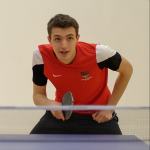
David’s been playing Table Tennis since he was 12, earning his first coaching license in 2012. He’s played in national team & individual competitions, although he prefers the more relaxed nature of a local league match! After earning his umpiring qualification in England, David moved to Australia and started Racket Insight to share information about the sport he loves.
Blade: Stiga WRB Offensive Classic | Forehand: Calibra LT | Backhand: Xiom Musa
Playstyle: The All-Rounder
BROSSARD, Que. — Itâ€s the second-to-last shift of Alex Newhookâ€s night, but heâ€s playing it like itâ€s his first.Â
Newhookâ€s energy is palpable as he takes a drop pass from Ivan Demidov, gains the offensive blue line, and sets up a premium scoring chance for Demidov in the slot in overtime. When Demidov collects his own rebound and resets, Newhook loops around to the point, gets a pass from Demidov, and attacks Sean Couturier and Jamie Drysdale to give himself a chance to score. And itâ€s at the very end of his shift that he makes his best play, pinning Drysdale behind the Philadelphia Flyers net and out-working him to get the puck back and send it back to safety to enable a Montreal Canadiens line change.
It’s about the details, and even this late in the game, on his 18th shift, Newhook is on top of them.
Itâ€s how the 24-year-old has been since the start of the season, fulfilling the promise he held as a player drafted 16th overall by the Colorado Avalanche in 2019.
Whatâ€s made it so?
“He was drafted because of his skating and his offensive ability,†said Canadiens coach Martin St. Louis earlier this week. “But he understood his growth as a player wouldnâ€t depend on his ability to skate faster or shoot harder; it would depend on him improving his intentions to play the game. The game often requires you to play defence; the game is mostly played without the puck. His intentions on the ice have improved so much that heâ€s become a much more complete player. And when youâ€re more complete, the game generally compensates you.â€
- 32 Thoughts: The Podcast
Hockey fans already know the name, but this is not the blog. From Sportsnet, 32 Thoughts: The Podcast with NHL Insider Elliotte Friedman and Kyle Bukauskas is a weekly deep dive into the biggest news and interviews from the hockey world.
Latest episode
So far, itâ€s given Newhook five goals and nine points through 13 contests.
But heâ€s contributed much more to the Canadiens†9-3-1 record.
At five-on-five, Newhook has been the safety valve for a line with two rookies — Demidov and Oliver Kapanen. Heâ€s been a play driver mostly from the wing, but also from the centre position. And on the penalty kill, heâ€s proven to be effective, despite not having played in the role since his debut in Colorado.
Before the start of the season, St. Louis approached the Newfoundland native about trading in a lifetime role on the power play, and Newhook offered no resistance.
“Itâ€s not every player who would be super happy with having something taken away from them,†said St. Louis, “but I tip my hat to him.â€
“I know he can play power play,†the coach added. “Right now, heâ€s proving to me he can kill penalties and do a good job of it.â€
Itâ€s been a work in progress — for both Newhook and the Canadiens, who currently rank 22nd in the NHL on the penalty kill.Â
But Newhookâ€s work as a player, in general, has brought him to another level.
“Heâ€s been great,†said Cole Caufield after Wednesdayâ€s practice.
Newhook said heâ€s been what he believes he should be — confident and consistent.
“My confidence is pretty high,†he said. “Iâ€ve built things to a point where I can be a difference-maker, and Iâ€m trying to be one every night. I feel like thereâ€s been points in games where I feel I can control the play pretty well and use my speed to really affect the game.â€
St. Louis said Newhookâ€s ability to do it defensively has not only served him well but also served as an example for his teammates.
You can see the player is process-driven and detail-oriented, and thatâ€s what the coach wants from all his players, especially after the process was flawed and the details were lacking in the loss to Philadelphia.Â
Newhook was as fallible on a couple of occasions at the start of Tuesdayâ€s game, but he finished it appearing like the same player whoâ€s been largely effective through the other 12 games.
What Newhook has shown is that he can be used in any situation, increasing his value to the team.
It is the objective he entered the season with, as he plays out his second-to-last year on a contract that pays him $2.9 million per.
Heâ€ll come out of that deal as a restricted free agent whoâ€s one year away from unrestricted free agency and in possession of arbitration rights, but he wants nothing more than to prove heâ€s an integral piece of the puzzle for the Canadiens.
“I played on a Stanley Cup-winning team (in Colorado), but I think this team is very special to be a part of,†Newhook said. “I think being here when things werenâ€t going as well, but also being here as the team was flashing its potential, it really makes you excited to be a part of that build. It means a lot to have been here through these stages. And now, to have an increased role and be used in all situations, Iâ€m taking a lot of pride in being here and being a part of this group, and hopefully being a part of our upcoming success.
“What Iâ€m trying to do here is prove that I can be a part of this core. I want to be here for a long time, and I think proving I can play on both sides of the puck and proving I can be a guy that can be relied upon is most important for me. Iâ€m going to continue to keep trying to prove it until the time comes.â€
So far, Newhook is succeeding.
The energy, versatility, and intention heâ€s bringing are elevating his status with the Canadiens. And the idea he can maintain that is being proven with each passing shift.
SPOTLIGHTED PODCAST ALERT (YOUR ARTICLE BEGINS A FEW INCHES DOWN)…
SHOW SUMMARY:ÂIn this edition of the new Wade Keller Audio News Bulletin, Wade covers these topics:
- Was the cleverness of Hangman’s Schiavone gag worth it? Did it make any sense? Is it symptomatic of industry-wide sloppiness?
- A list of little things that are sometimes done well, usually aren’t, but how applying a higher standard for tweaking things to feel more real and more logical can pay off
- News items on AEW PPV refunds, a Mike Rotunda health clarification from the family, Nikki Bella comments on her current run, and a Thunder Rosa injury update
EMAILS…
pwtorch@gmail.com for any news tips for a future Wade Keller Audio News Bulletin
wadekellerpostshow@gmail.com for any email directly related to Raw, Dynamite, or Smackdown written the night of the show as it airs
wadekellerpodcast@gmail.com for any questions for the weekly Wade Keller Podcast Flagship episodes, so this is more topical in-the-news questions that cover the current scene
askwadekeller@gmail.com for any questions for a future VIP-exclusive Wade Keller Ask the Editor podcast with more general topics, historical, philosophical, whimsical, etc. that isn’t necessarily tied to just that week’s top stories (although they can be!)
DIRECT LINK:Â VIP AUDIO LINK
NOT VIP? NO PROBLEM… CLICK HERE FOR VIP SIGN UP INFO
OTHER LINKS…
Or support us on Patreon…
Subscribe to our YouTube Channel…
Emails…
wadekellerpodcast@gmail.com
kellerwade@gmail.com
pwtorch@gmail.com