- Bollywood Icon Shah Rukh Khan Comments On Meeting John Cena
- Dave Meltzer Offers An Update On WWE Star Shinsuke Nakamura’s Potential NJPW Return
- 2025 World Series Game 6 storylines, what to watch
- Eddie Guerreroâ€s Daughter Sherilyn Begins Training at Booker Tâ€s Reality of Wrestling
- LeBron James announces new Halloween children’s book
- Former Wes Lee sets date for return to indies
- Sources: NBA, books review most vulnerable bets, wager limits
- Drew McIntyre Smashes TV in Rage Room Before WWE Title Match Against Cody Rhodes
Browsing: coaches
Between 2020 and 2023, Skinner lived away from her partner to manage Spurs. She felt “burned out” by the time of her dismissal.
While Premier League managers often have multiple members of support staff, a lucrative financial package when they join, and longer, secure contracts with better pay-out clauses, that is not often the case in the WSL.
Managers could be expected to move homes, quit full-time jobs and temporarily leave their partners, despite only being offered an 18-month contract.
They often take on a host of responsibilities, with few senior staff at women’s clubs, placing more stress on them to recruit players in the transfer window, for example.
Their average salaries, while undisclosed, are believed to be around £70,000 – although that figure is skewed by a few abnormally high wages at wealthier clubs.
At international level, Lionesses boss Sarina Wiegman is reportedly on an annual salary of £400,000, plus performance-related bonuses, while men’s manager Thomas Tuchel earns £5m per year.
The reality, therefore, is that they cannot afford to be out of work for long.
Ex-Manchester United manager Casey Stoney was sacked as head coach of American club San Diego Wave while she had temporarily returned to England for a funeral. She, and her family, were unable to return to their California home as their visas had been terminated.
“There’s pressure on every game, and scrutiny of what you’re doing with little understanding of what goes on behind the scenes – the lack of infrastructure, number of staff and player availability,” added Skinner.
“A lot of clubs don’t have strong senior staff because of the lack of resourcing so that requires more from the manager. What you are paid doesn’t match up to the expectations.
“It was hard for me when I left Tottenham because of the amount I personally invested in it. When you look back, you think to yourself, ‘I’m not sure why I did that?’
“You’re on your own a lot and it’s a lonely place to be.”
Oct 27, 2025, 01:02 PM ET
The opening week of the NBA season was rocked by Thursday’s news of two federal investigations related to illegal sports betting and rigged poker games. The arrests of Portland Trail Blazers coach Chauncey Billups, Miami Heat guard Terry Rozier and former player and assistant coach Damon Jones have sent shock waves through the basketball world.
Many current players and coaches have chimed in, sharing their reaction to the news, how they’ve been impacted by the rise of sports betting, and what could lie ahead for the league’s expanding role in the space.
MORE: What we know about the Billups-Rozier NBA gambling cases
On the news of Thursday’s arrests:
play
0:48
Spoelstra, Adebayo react to Terry Rozier’s arrest
Erik Spoelstra and Bam Adebayo talk about moving forward after Heat guard Terry Rozier’s arrest.
Erik Spoelstra, Miami Heat head coach:
“Terry is somebody who is very dear to all of us. He has had a real positive impact on our locker room, on staff and players alike. That includes last year when he wasn’t in the rotation often times. So you send our thoughts and care for him as he goes through it.”
Rick Carlisle, Indiana Pacers head coach and president of the coaches’ association:
“It’s a shocking day. I reached out today to Chauncey to see how he was doing. He did not answer, but the coaches’ association, we support all of our coaches. So, reached out to him and his representatives and I’ll just kind of leave it at that. But yeah, and this is a very serious situation. The irony I guess of it is from my perspective, yesterday was a day when our general counsel came down and read us all the regulations on gambling and warned our coaching staff, our players, our support staff, about all these different things. In terms of the details of the allegations, I don’t know any of that, but it’s a world that’s a different world than it was a few years ago with the advent of legalized gambling. And I guess there’s another aspect of this is unrelated to basketball, so I will not comment on that, but a shocking day, and we will see what happens as all the facts [are] collected.”
Editor’s Picks
2 Related
J.B. Bickerstaff, Detroit Pistons head coach:
“[Billups is] a friend of mine. I’ve known him since I was in the seventh grade. You know, I care about him immensely, and I hate to see what he’s going through right now. As a friend, as a human, I’m here to support him and be there for him in any way that he needs me to be. And I know just how difficult this time is, and I think everyone needs to allow the due process to happen, and then obviously judgments can be made.
“But you feel for anybody who you’ve known that long, have a relationship with, [I] know his family well. So you know, I know he’s going through it. I know it’s a difficult time for him, but all of us as friends and coaches are there for him.”
Draymond Green, Golden State Warriors forward:
“I was shocked. I woke up to that news, and I had overslept for shootaround. So when I woke up, I couldn’t really check in on it. I got here, and they’re like, ‘Man, you see everything that happened?’ I’m like, ‘Ah, not quite.’ I only knew about Terry. … I wish everybody well. It’s a tough moment for the individuals involved. It’s a tough moment for the league.”
On how sports betting has impacted players and coaches
play
2:24
Shaq: ‘All these guys knew what was at stake’
Shaquille O’Neal reacts to news of the FBI’s gambling investigation involving Terry Rozier and Chauncey Billups.
JJ Redick, Los Angeles Lakers head coach:
“We’ve had two meetings on it already. It’s obviously on the front of everyone’s awareness given the last two years.”
Jaylen Brown, Boston Celtics forward and VP of the National Basketball Players Association:
“That whole world was introduced a couple years ago, and I don’t think they took players into consideration — especially with the energy, the behavior that goes around gambling and how that directly correlates with players. We don’t benefit from any of the profits, but we’ve got to deal with a lot of the extra negativity and scrutiny behind all the gambling stuff. On top of that, it creates more integrity issues. I’m not sure what the answer is, but definitely something that people have to spend more time having conversations about. …
“There’s been little to no conversation around [protecting players]. It’s all about, ‘How can we increase business and revenue?'”
Billups, Rozier among 34 arrested by FBI
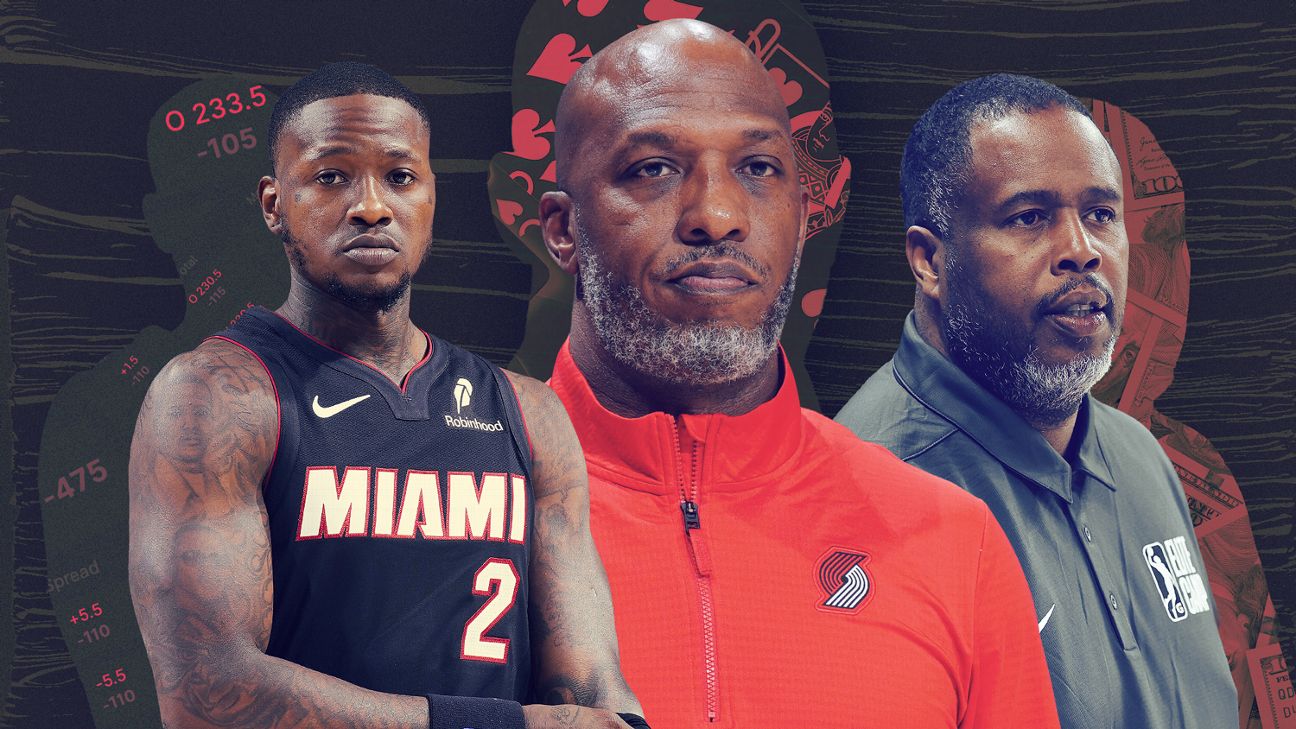
Trail Blazers coach Chauncey Billups, Heat guard Terry Rozier, and former Cavaliers player and assistant coach Damon Jones were arrested as part of a pair of wide-ranging investigations related to illegal sports betting and rigged poker games backed by the Mafia, authorities announced.
• FAQ: What we know about the cases
• Leaguewide reaction: Players, coaches weigh in
• Timeline: Sports betting scandals since 2018
• Wetzel: True cost of sports betting
• Greenberg: How FBI says poker games were rigged
Nikola Vucevic, Chicago Bulls center:
“I think in general, gambling is a big problem, not only here, but worldwide. I think now that it’s got into sports here, lot of people are involved in it. A lot of people get stuck, and it’s hard to get out. All you gotta do is download the app. We as players feel it a lot when we step on the court. Before you used to hear, ‘Vuc, get a win.’ Or, ‘Hey, do this and that.’ Now it’s like, ‘Hey, my parlay is 10 rebounds.’ Honestly, it pisses me off, because it’s disrespectful to the game.”
Jamahl Mosley, Orlando Magic head coach:
“Before the year even starts, we address the team right away, talking about all the things that go on. The league sends memos, we watch videos about rules and regulations of the gambling and betting. We have done that with our team. [The FBI investigations] was another reminder of what we have to do. We had another conversation with the group, and the more that is going on, the more that we have to continue to talk to the group about the things that are happening. And the league does a great job of making sure that we communicate that to our guys and the organization.”
Bickerstaff:
“You know that information has been monetized now, and whether you know you like it or not, it’s a part of it. It is what it is. So you have to be extremely careful. And we’ve had a ton of conversations with our guys about that and just how sensitive it is. … You’re having an innocent conversation with a friend of yours, but who knows what that friend does with that information. We’ve talked about it, the conversations you have to have with your own families now about the importance of that information. …
“When you get in bed with sports betting and gambling, there’s a lot of things that come with it, and earlier on in this process, everybody’s going to have to weed their way through it until you become accustomed to it. But, you know, all money ain’t good money. And this puts a ton of pressure on our guys, on coaching staffs, on families that, I don’t know if we were aware of or prepared for, but it’s definitely made it much more difficult on all of us.”
On the NBA’s expanding role in sports betting:
play
1:51
Chuck and Kenny react to NBA gambling investigations
Charles Barkley and Kenny Smith get into a disagreement about whether Terry Rozier’s and Chauncey Billups’ situations are a result of a gambling addiction or if it’s “pure stupidity.”
Green:
“I’m not going to sit here and be like, ‘Man, y’all partner with a gambling company and you open a can of worms.’ That can of worms [will] be opened with partnering with gambling companies or not. Partnering with gambling companies won’t make gambling more accessible to us. The accessibility is what it is. If you’re an American or you live in America and you live in states where gambling, sports betting is legal, it pops up right on your phone. Whether the league is partnered with the company or not, that ain’t changing nothing. So I think those partnerships are going to continue to grow. …
“Our league has done an incredible job of growing this game. Partnerships come when you grow the game, and for all of us, from ownership to players, it grows the pot. And I haven’t heard anyone complain about the pot growing. …
“It’s going to keep changing. In more and more states [sports gambling] is going to become legal, so that’s not going away. If anything, it’s going to go further in the direction that it’s already headed.”
Stephen Curry, Warriors guard:
“I think on the whole everyone is very mindful of what to do and what not to do. It’s not just an NBA thing. This is new territory for everybody. We all are very responsible. The integrity of the game is fine.”
Mitch Johnson, Spurs head coach:
“The league, the game and the business of the league have evolved. So, we just have to be aware of how things evolve in this business, right? In our little world, sometimes we get lost in that. So, it’s very important for us to continue to just be educated and mindful of everything that has to do with our business.”
ESPN’s Jamal Collier, Vincent Goodwill, Dave McMenamin, Anthony Slater, Michael C. Wright and Ohm Youngmisuk contributed to this story.
After over a decade of continuity for the Warriors, it’s clear that nobody in the organization gets special treatment. Not even the centerpiece.
Two-time NBA MVP Steph Curry is coached the same way as everyone else. Draymond Green elaborates on coach Steve Kerr’s style.
“Most people think Steph can do what he wants,” Green said. “No. He’s on Steph’s ass all the time. Defense, turnovers. He coaches Steph really, really, really hard. I don’t think people realize that.”
There have been multiple occasions where Kerr has shown his frustration with Curry through his body language. In a game early in the 2023 season, Curry flung a careless fourth-quarter pass in Minnesota, landing out of bounds near Kerr. The coach stomped around in disgust on the sidelines.
“The next day I pulled him aside,” Kerr said, relaying his message to Curry. “‘Hey, I was watching the tape and I saw my reaction, I shouldn’t have done that.'”
Curry’s response: “Hell no. That was a terrible decision. You got to coach me.”
Many coaches live by the theory that your best players should be coached the hardest in front of everyone to set the tone. Sometimes this can lead to a disconnect between star play and the coach.
“Not all players in this league can handle that being put out to the public,” Kerr said.
Curry is a rare breed. On the court, everyone can see why, but it’s his temperament outside the lines that can be overlooked.
“He actually probably gets on me more now than ever,” Curry said. “The one conversation we’ve had is to coach me like you would coach everybody because that’ll help strengthen your voice in the locker room, create that trust.”
Creating a culture starts with building an identity and holding everyone involved to the highest standard, including one of the best players of all time.

Boston Celtics coach Joe Mazzulla says Tuesday’s pickup game between coaches and media was no laughing matter.
Clips of the game, in which media members were outscored 57-4, went viral as commenters reacted to Mazzulla’s decision to pit reporters against a team stocked with former NBA and college basketball players.
“It’ll be laughed at and joked about, but it means a lot more to humanize. We have too many interactions where it’s coach and everyone’s doing their job,” Mazzulla told reporters Thursday, per Celtics Blog’s Noa Dalzell.
Mazzulla continued, “So if anything, we have to do it more, because it humanizes the competition, and I realize how much you guys really like the game and care about it, so I hope that it doesn’t drag on as something that’s funny, it’s something that was serious.
“I meant that, and that was important that we did that yesterday. And we’ll do it again.”
In her story recounting the game, Dalzell described the dominance displayed by Mazzulla and his teammates including former NBA players Phil Pressey and Da’Sean Butler.
“To describe it as a disaster for us reporters would be an understatement,” Dalzell wrote. “The sheer gap in athleticism — speed, size, instincts, you name it — felt so insurmountable that I can hardly pinpoint what even went down.”
But Mazzulla pointed to what he described as a “shove” by Boston Sports Journal’s John Karalis on Hardwood Houdini’s Jack Simone as an example of what media members and the Celtics coaches had in common.
“It’s no different than me getting pissed at [Simone’s] question the other day,” Mazzulla said, per Dalzell. “It’s a competitive reaction to the thing that’s going on.”
According to Dalzell, Tuesday’s pickup game was originally scheduled to only be played between media members. If Mazzulla’s comments are any indication, there could now be more media-coaches matchups in the future.
Mazzulla will now turn his attention to the start of the 2025-26 regular season, which his team will be entering without injured star Jayson Tatum. Jaylen Brown will be set to lead the Celtics into next Wednesday’s season opener against the visiting Philadelphia 76ers.
As the 2025-26 NBA season is about to tip off, we’ll soon learn which teams work, and which teams will be forced to make alterations in the future. But that doesn’t mean we can’t guess our way to something beforehand about the current outlooks of certain franchises that might need organizational changes soon. Here are five teams to keep an eye on.
Heat: What’s the plan, Pat?
All right, all right. It’s unfair to pin the latest round of mediocrity on just Pat Riley, as GM Andy Elisburg also has some serious sway in the organization. Yet you have to wonder how long the Heat can maintain their steadfast refusal to rebuild. They have good players, and quite a few of them, but they simply do not have in their possession a player who can carry them into the Finals now that Jimmy Butler is no longer on the roster.
Advertisement
[High Score is a new way to play Fantasy Basketball on Yahoo with simple rosters and scoring. Create or join a league]
Look, the Heat will be competitive. They’ll fight. They’ll be scrappy. They’ll win games they frankly have no business winning. But ultimately, this team has a fairly set ceiling, despite acquiring Norman Powell for freaking peanuts. Could this season, if they finish in the play-in again, prove to shake the foundation of Heat culture? Maybe, maybe not. But at the very least, it wouldn’t be the worst idea in the world to be open to new interpretations of roster construction.
(Mallory Bielecki/Yahoo Sports Illustration)
Pelicans: Can Willie Green survive the hot seat?
The arrival of Joe Dumars to helm the front office has already been a disaster in terms of asset evaluation. One look at this roster, and it’s clear the odds are against the Pelicans making any type of competitive push. With an increasingly angered fan base, eventually the organization is going to need a fall guy, and that person is unlikely to be Dumars.
Advertisement
[Yahoo Sports TV is here! Watch live shows and highlights 24/7]
Enter Willie Green, who is entering his fifth season as the organization’s head coach. So far, he has won 148 games, lost 180 and hasn’t exactly stood out as a beacon of hope for fans. While he’s done reasonably well given the circumstances, 10 total playoff games isn’t enough to save him from the chopping block, especially if the team starts poorly and the franchise needs an excuse to keep fans invested.
It appears all the more likely Green will be out of there if things go sideways. Is it fair? Probably not. But when has that ever stopped any NBA organization from firing its coach?
Bucks: Eh, what’s up, Doc?
Doc Rivers is notorious for avoiding responsibility, blaming his players, not playing young guys and installing offensive systems that lack nuance. With the Bucks firmly up against the wall, after waiving and stretching Damian Lillard, and spending their last remaining bullets on signing Myles Turner, they’re going to look for a scapegoat as soon as Giannis Antetokounmpo sneezes, and odds are good that will be Rivers.
The twist is that firing Rivers would easily be justified, even without the element of a scapegoat, but that probably won’t stop the Bucks from applying that logic anyway, seeing as Rivers is easier to replace than making significant roster upgrades. (That’s what happens when you decide to paint yourself fully into a corner.)
Advertisement
Of course, it shouldn’t just be Rivers potentially seeing his head roll here. The franchise spends more time being concerned about retaining Antetokounmpo than actually trying to build a contender around him, which is what he wants. General manager Jon Horst and the front office have spent years attacking the problem from the wrong angle, and seem hell-bent to continue that pattern for … reasons?
We’ll see if the Bucks come out swinging and use the downfall of the Celtics and Pacers to their advantage. If they do, perhaps they all slide into safety. But that won’t leave Bucks fans particularly optimistic about the future.
Hornets: Come on, just sting a little!
Hornets are usually very protective of their colony and are ready to throw down in tough times. That hasn’t been the case for a while in Charlotte. This organization is all over the place to the point where we can’t limit any one person to becoming the sacrificial lamb. If this teams starts off poorly again, especially with a healthy roster, everything should be on the table, including moving off, yes, LaMelo Ball.
Advertisement
The roster lacks cohesion and symmetry, and has developed habits that make you wonder if it can ever turn the narrative around as a collective group. This team needs better players, a stronger strategy and a true long-term plan, all of which seem to be a bit of an afterthought these days. Organizational changes should be more than welcome, especially if the Hornets are far below .500 when the calendar turns to 2026.
Bulls: Is there currently a more unserious NBA franchise?
The answer is a resounding no, and that’s not the worst part. Including them here, which intends to point toward possible reactions to poor performance, is actually a joke, because they don’t make changes. In fact, the front office and coaching staff, namely ArtÅ«ras KarniÅ¡ovas and Billy Donovan, seem to continue receiving contract extensions for a job not done, by just finding themselves in the play-in tournament every year.
Advertisement
If the league had such issues with the Philadelphia 76ers that it decided to move Sam Hinkie off his post during The Process, what exactly is keeping it from doing the same to the Bulls? At least The Process Sixers had a plan and made a genuine attempt at acquiring future stars, to a point where they could compete for a championship.
The Bulls are standing still, by choice, and that should infuriate the league enough to reach out to Mr. Burner, Bryan Colangelo, to at least do something other than what’s currently being done. (That’s a joke. No team should entertain Colangelo as a real option.) But the point stands. This organization rewards its own members in reaching pointless mediocrity, and if that isn’t grounds for change, then what is?
The New York Mets are remaking their major league staff after they fell short of a postseason berth, naming a new bench coach and lead hitting coach, sources told ESPN.
The Mets are hiring Kai Correa as their bench coach, sources confirmed to ESPN. Correa will be manager Carlos Mendoza’s right-hand man and comes to New York after a previous stint as bench coach and interim manager in San Francisco and serving as an integral part of Cleveland’s coaching staff since 2024.
Jeff Albert, the Mets’ director of hitter development, will serve as the team’s lead hitting coach in 2026 and be in uniform, sources told ESPN.
Editor’s Picks
While Albert’s title has not been defined, he was formerly the hitting coach of the St. Louis Cardinals. Albert, 44, joined the Mets in November 2022 and has worked in a development capacity, helping the team rebuild a system that has its strongest group of hitting prospects in years.
Albert also spent six years with the Houston Astros, where he worked with Mets president of baseball operations David Stearns. The Mets plan to bring in another coach to complement Albert, sources said, after they fired hitting coaches Jeremy Barnes and Eric Chavez as part of a staff revamp that also included the departures of pitching coach Jeremy Hefner, bench coach John Gibbons, third-base coach Mike Sarbaugh and catching coach Glenn Sherlock.
Following a 45-24 start, the Mets cratered over the season’s final 3½ months and finished 83-79, losing a tiebreaker with the Cincinnati Reds for the final National League wild card spot.
The Mets’ offense finished 10th in Major League Baseball in runs scored and returns most of their core, including outfielder Juan Soto, shortstop Francisco Lindor and outfielder Brandon Nimmo. First baseman Pete Alonso said he plans to opt out of his contract and will become a free agent for the second consecutive season.
News of Correa’s hiring was first reported by Pat Ragazzo.
Media covering the Boston Celtics were supposed to play a pickup game among themselves at Boston’s practice facility on Tuesday. Celtics coach Joe Mazzulla had other plans.
Editor’s Picks
1 Related
The Celtics told reporters that they could use the Auerbach Center courts for a media game after practice. When asked about the game, Mazzulla shared news of a change.
“Don’t want to break it to you, but you’re not playing against each other. You’re playing against the coaches,” he told reporters.
The game went exactly how one would anticipate it to go. Mazzulla and his staff dominated the 12-minute game, winning 57-4.
Mazzulla’s staff includes multiple former NBA players such as 6-foot-9 forward Amile Jefferson, guard Phil Pressey, 6-7 forward Da’Sean Butler, who is Mazulla’s former college teammate, and God Shammgod. Mazzulla — a four-year player at West Virginia — suited up, too.
Celtics stars Jaylen Brown and Jayson Tatum watched from above the practice court.
“It’s hard to even describe what went down in the game. To describe it as a disaster for us reporters would be an understatement. The sheer gap in athleticism — speed, size, instincts, you name it — felt so insurmountable that I can hardly pinpoint what even went down,” Celtics on CNLS reporter Noa Dalzell wrote. “I’d love to take a look at a box score, but the amount of live-ball turnovers we accrued would probably make me sick.”
The media members eventually played their pickup game afterward. The white team defeated the green team 25-22 — a stark contrast from the earlier contest.
Information from the Associated Press was used in this report.
Image credit:
Tony Vitello (Photo by Eddie Kelly/ ProLook Photos)
In this week’s Future Projection, Ben Badler and Carlos Collazo discuss the Tony Vitello-to-the-majors rumors and brainstorm on the skills that would or wouldnâ€t translate from the college game to the majors.
Should MLB teams be looking for more managers from the college ranks? And why donâ€t we see more MLB/college coaching crossover in general?
We then talk about which of the current MLB manager vacancies would be the most and least appealing.
Time Stamps
- (0:00) Cam Schlittler
- (10:30) Tony Vitello—big league manager?
- (17:00) The value of college head coaches vs. MLB managers
- (25:00) Lifestyle of college jobs vs. MLB managers
- (37:30) The media scrutiny of an MLB manager
- (40:00) Should major league teams recruit college coaches more frequently?
- (51:00) Pat Murphy as a successful example
- (55:00) Which MLB manager jobs are the most/least appealing?
- (1:02:00) The Rockies & the Coors Field problem
- (1:09:30) A question about MLB ball adjustments
Want more podcasts like this one? Subscribe below!
NEW YORK — Following a difficult campaign that saw them miss the playoffs on the seasonâ€s final day, the Mets are significantly shaking up their coaching staff.
Hitting coaches Jeremy Barnes and Eric Chavez and pitching coach Jeremy Hefner are among those who will not return, the team announced. The Mets are also parting ways with bench coach John Gibbons and third-base coach Mike Sarbaugh, while catching instructor Glenn Sherlock is retiring.
Manager Carlos Mendoza, whom the Mets will bring back for the third and final guaranteed year of his contract in 2026, will enter that campaign with a markedly different cast around him.
“Itâ€s normal after any season to do a coaching staff evaluation,†president of baseball operations David Stearns said earlier this week. “When you come off of a disappointing season like this, itâ€s certainly going to be a little more intense.â€
Barnes, 38, had been part of the Mets†hitting program since 2022, after serving one year in a player development role. He became the clubâ€s hitting coach the following season and shared that job with Chavez the past two years. Before that, Chavez, 47, had served as the Mets†bench coach for one season under Buck Showalter.
Under Barnes and Chavez, the Mets finished fifth in the Majors in wRC+ (112), eighth in batting average with runners in scoring position (.260) and tied for ninth in runs per game (4.73).
Hefner, 39, spent six seasons in the organization. Originally hired by Brodie Van Wagenen to serve as Carlos Beltránâ€s pitching coach, Hefner survived multiple front-office and managerial changes to become the Mets†longest-tenured coach.
Last year, Hefner led a surprising Mets pitching staff to a 3.96 ERA, enjoying notable success with free agents Luis Severino and Sean Manaea while also helping establish the organizationâ€s high-tech pitching lab in Port St. Lucie, Fla. But the team took a slight step back this year due in part to a slew of injuries (Manaea, Kodai Senga, Griffin Canning, Tylor Megill, Frankie Montas and A.J. Minter were among those to miss significant time), producing a 4.03 ERA as a staff. That ranked 18th in the Majors.
Assistant pitching coach Desi Druschel and bullpen coach José Rosado have been given permission to speak to other teams, pending the Mets†selection of a new head pitching coach. Itâ€s unclear at this point if either will return.
Gibbons, 63, a former Mets player who later spent two stints managing the Blue Jays, had served as bench coach the past two seasons. His hire before the 2024 campaign was significant because it gave Mendoza, who at the time had no Major League managerial experience, a veteran hand in the dugout.
Sarbaugh, 57, spent two years as third-base coach following an 18-year run in the Guardians organization.
Sherlock, 65, had been the Mets†catching coach for the past four seasons, working closely with Francisco Alvarez and other Mets backstops. He previously served as a base coach for the Mets from 2017-19.
Image credit:
LSU coach Jay Johnson (Photo by Isaac Wasserman/NCAA Photos via Getty Images)
College baseball coaching salaries donâ€t touch the stratosphere of those in football or menâ€s basketball, but the industry has seen a sharp rise in recent years.Â
More coaches than ever now clear the $1 million mark annually. This offseason alone produced landmark contracts, as LSUâ€s Jay Johnson became the highest-paid coach in the sportâ€s history and Mississippi Stateâ€s Brian Oâ€Connor joined the exclusive group making at least $2 million per year.
Below, we’ve compiled a list of the top 15 head coaching salaries in college baseball. The order reflects average annual pay before bonuses, based on documents obtained by Baseball America.
1. Jay Johnson (LSU)
- Average annual salary: $3.35 million
On the heels of its second national championship in three years, LSU finalized a new contract with Johnson that made him the highest-paid coach in college baseball. The deal starts at $3.05 million, edging past Tennesseeâ€s Tony Vitello, whose $3 million salary previously set the market. They are now the only two coaches in the country earning more than $3 million annually. Johnsonâ€s salary will climb by $100,000 each year until it reaches $3.65 million, with the contract running through 2032. Itâ€s a gaudy but well-earned figure for one of the gameâ€s brightest minds.
2. Tony Vitello (Tennessee)
- Average annual salary: $3 million
After guiding Tennessee to the 2024 national championship, Vitello signed a new deal that briefly made him the sportâ€s highest-paid coach. While he no longer holds that title, the Volunteers†head coach will always hold the crown as the sportâ€s first to reach the $3 million mark. His contract runs through 2029, cementing his place near the top of the profession alongside Johnson.
3. Brian Oâ€Connor (Mississippi State)
- Average annual salary: $2.9 million
How do you attract one of college baseballâ€s most accomplished coaches? You pay him like it. Mississippi State lured Oâ€Connor away from Virginia with a massive contract averaging $2.9 million annually, immediately placing him among the highest-paid skippers in the country. Oâ€Connor, who guided the Cavaliers to a national championship and multiple Omaha trips, now anchors the Bulldogs†future in the SEC with a deal that reflects both his pedigree and the escalating salary market.
4. Tim Corbin (Vanderbilt)
- Average annual salary:$2.45 million
Because Vanderbilt is a private school, Corbinâ€s salary isnâ€t available through public records. But tax documents and industry sources place his average annual pay at $2.45 million. That makes him one of just five coaches whose compensation eclipses the $2 million mark. Widely regarded as one of the sportâ€s all-time greats, Corbin is one of only 17 coaches to win multiple national championships.
5. Jim Schlossnagle (Texas)
- Average annual salary:$2.2 million
When Schlossnagle left Texas A&M for rival Texas in 2024, he signed a backloaded deal that paid $1 million in each of its first two years before climbing to $2.68 million annually over the final five seasons. The average works out to $2.2 million, placing him firmly among the sportâ€s elite earners. His move within the Lone Star State ruffled plenty of feathers in College Station, but money talks, and the Longhorns spared nothing to secure one of college baseballâ€s best.
6. Tim Tadlock (Texas Tech)
- Average annual salary:$1.89 million
Tadlock signed a rolling seven-year deal in 2021 that automatically extends by a year unless the school notifies him otherwise by Aug. 15. The contract includes a unique provision requiring biannual reviews to ensure his compensation “remains in the top five†in the sport. He currently ranks sixth, though, after Jay Johnsonâ€s recent extension reset the market. Sources place Tadlockâ€s average annual salary at $1.89 million, with his next salary review scheduled for September 2027. He remains the sportâ€s highest-paid non-SEC coach.
7. Kevin Oâ€Sullivan (Florida)
- Average annual salary: $1.84 million
Oâ€Sullivan signed an extension before the 2024 season that made him the nationâ€s second-highest paid coach at the time and secured his place in Gainesville through 2033. Since taking over in 2008, he has guided Florida to more College World Series appearances than any other active coach, highlighted by the programâ€s 2017 national championship. His $1.84 million average salary reflects both his longevity and consistent success.
8. Mike Bianco (Ole Miss)
- Average annual salary:$1.625 million
Bianco, the longest-tenured coach in the SEC, carries an average annual salary of $1.625 million. He delivered the Rebels their first national championship in 2022, cementing his legacy in Oxford and ensuring his place among the sportâ€s highest earners.
9. Butch Thompson (Auburn)
- Average annual salary:$1.5 million
Following a 41-win season and a near-miss of the College World Series, Auburn extended Thompson through 2031 on a deal worth $1.5 million annually. The contract features two potential rollover years tied to NCAA Tournament appearances, which could carry it through 2033. There are also performance incentives that can elevate his total compensation.
10. Dave Van Horn (Arkansas)
- Average annual salary:$1.45 million
One of the best coaches yet to win a national championship, Van Horn has built a reputation for elite player development and sustained success in Fayetteville. His contract runs through 2031 at an average of $1.45 million, which rounds out the top 10.
11. Erik Bakich (Clemson)
- Average annual salary:$1.4 million
Bakichâ€s first two years at Clemson were strong enough that the school quickly extended him through 2030. The deal boosted his salary to $1.4 million annually, a figure that placed him inside the top 10 nationally at the time. Now, he has the Tigers on the cusp of a College World Series return, with his compensation reflecting the programâ€s upward trajectory.
12. Dan McDonnell (Louisville)
- Average annual salary: $1.35 million
McDonnell, one of the sportâ€s most consistent winners, earns an average annual salary of $1.35 million. Since taking over in 2007, he has elevated Louisville into a national power, guiding the Cardinals to six College World Series appearances and setting the standard for ACC consistency. McDonnell, like several other coaches on this list, has seen his salary grow with the sport, having served in his role for nearly two decades.
13. Paul Mainieri (South Carolina)
- Average annual salary:$1.3 million
South Carolina lured Mainieri out of retirement before the 2025 season with a deal that averages $1.3 million annually and places him among the top 15 highest-paid coaches in the nation. Year one was rocky, as the Gamecocks stumbled to a 28-29 record and just six SEC wins, but Mainieri and his staff responded with a massive transfer portal haul aimed at jump-starting a turnaround.
14. Wes Johnson (Georgia)
- Average annual salary: $1.3 million
Amid offseason rumors linking him to other jobs, Johnson this year reaffirmed his commitment to Georgia by signing an extension through 2031 that raised his average annual salary to $1.3 million. Originally hired ahead of the 2024 season, he quickly revitalized a program that had missed the NCAA Tournament in six of the previous nine years and hadnâ€t advanced past regionals since 2008. Johnson is the winningest coach through two seasons in Georgia history, guiding the Bulldogs to a super regional in year two and positioning them as a national seed contender.
15. Skip Johnson (Oklahoma)
- Average annual salary: $1.28 million
Johnson earns an average annual salary of $1.28 million, placing him just inside the top 15 nationally. Since taking over in 2018, he has guided Oklahoma to steady improvement—highlighted by a trip to the 2022 College World Series finals—and positioned the Sooners as a consistent Big 12 contender. Now in the SEC, the challenge is steeper, and his compensation reflects the step up in competition, aligning him with many of his new peers.